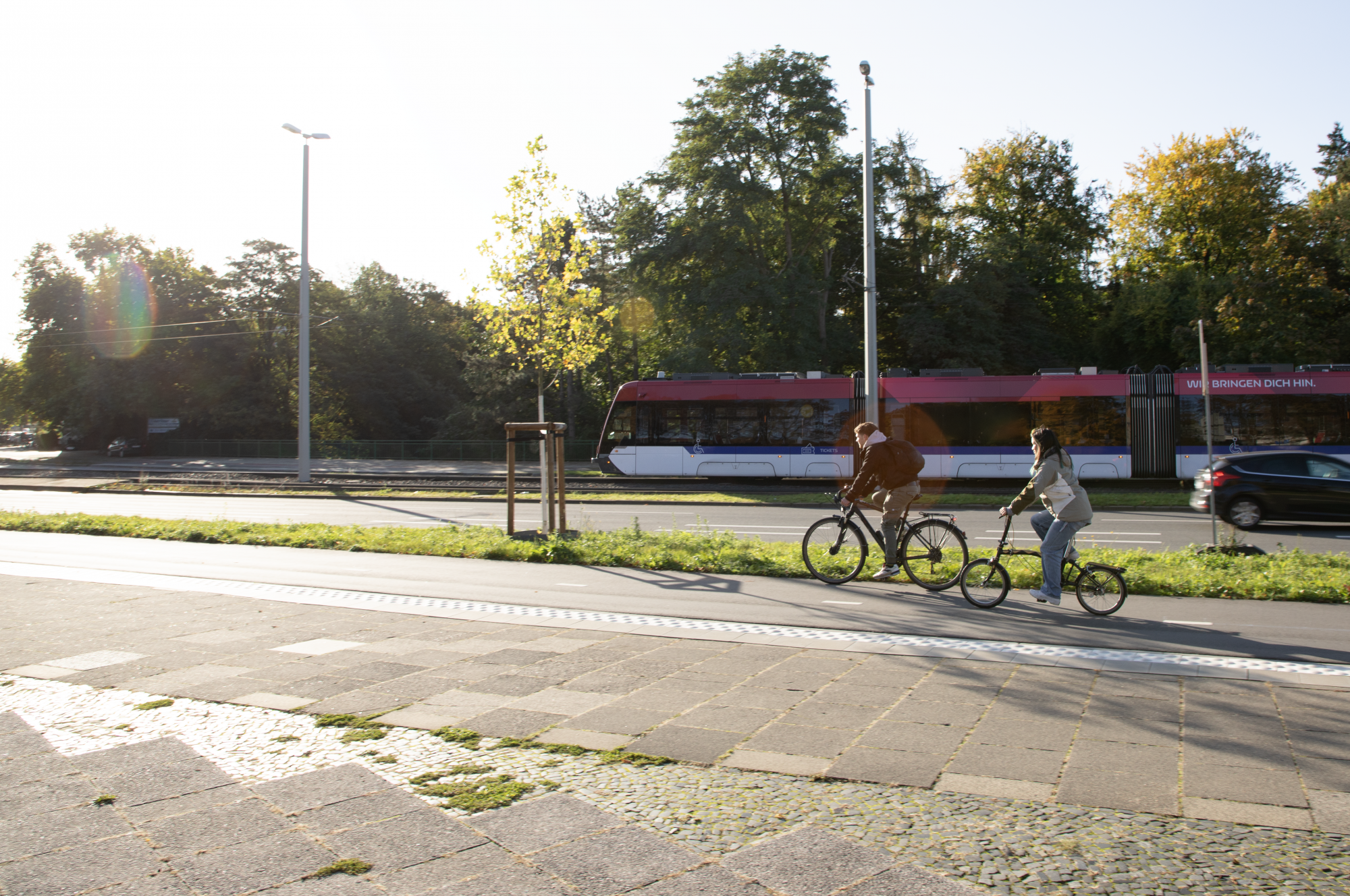
Jana Kühl was appointed to the endowed professorship for cycling funded by the German Federal Ministry for Digital and Transport in 2020. Since then, an interdisciplinary team with backgrounds in geography, design, communication studies, history, and urban/regional management has been exploring how cycling and mobility cultures shape processes of societal transformation.
„Culture is about how social groups develop and retain distinctive features; how they convey meanings and identity; and how they maintain membership over time. Put very simply, culture comprises similar patterns across a group of people in how they think, what they do and what they have.”
(Stephenson, 2023)
Cultures can be understood as figurative “templates” of thought and action through which communities largely act in routinised ways and which simultaneously define social norms. A key characteristic of cultures is that they are transmitted over time, meaning they are often adopted in largely unreflected ways and therefore exhibit a certain degree of stability. At the same time, cultures are identity-forming: individuals experience belonging by sharing values, engaging in similar routines, recognising one another, and understanding shared practices.
As long as a culture persists, it provides its members with a sense of security and certainty about belonging and about “doing the right thing.” However, when such a culture is called into question, the identities and self-understandings of its members are also challenged, which often triggers defensive reactions. This also applies to the field of mobility and its associated cultural phenomena (Hoor, 2020).
According to Götz and Deffner (2009), mobility cultures refer to “the entirety of materially and symbolically effective practices related to movement and mobility. This includes transport infrastructure and urban design as well as guiding principles, transport policy discourses, the behaviour of transport users, and the underlying mobility and lifestyle orientations. […] It describes the processual interaction of urban actors, infrastructures, and technologies as a ‘situated’ socio-technical system.”
Mobility cultures shape how societies understand, practise, and organise mobility in similar ways. This understanding influences the actions of private individuals as well as those of policymakers, planners, and economic actors. In car-centric mobility cultures, for example, there is often an implicit and largely unquestioned consensus regarding car use as an appropriate and desirable mode of transport. This is also reflected in specific expectations and norms, such as the unquestioned importance of parking spaces and the taboos surrounding speed limits.
- Götz, K., & Deffner, J. (2009). Eine neue Mobilitätskultur in der Stadt – praktische Schritte zur Veränderung. In Bundesministerium für Verkehr, Bau und Stadtentwicklung (Hrsg.), Urbane Mobilität. Verkehrsforschung des Bundes für die kommunale Praxis (S. 39–52). Bonn: BMVBS.
- Hoor, M. (2020). Mobilitätskulturen. Über die Notwendigkeit einer kulturellen Perspektive der integrierten Verkehrsplanung (IVP Discussion Paper, Heft 1).
- Manderscheid, K. (2024). Mobilitätspraktiken in der Automobilgesellschaft: Zur Wechselwirkung von räumlichen, zeitlichen und verkehrlichen Strukturen. In W. Canzler, J. Haus, A. Knie, & L. Ruhrort (Hrsg.), Handbuch Mobilität und Gesellschaft. Springer VS. https://doi.org/10.1007/978-3-658-37804-2_8
- Stephenson, J. (2023). Culture and Sustainability: Exploring Stability and Transformation with the Cultures Framework. Palgrave Macmillan.